
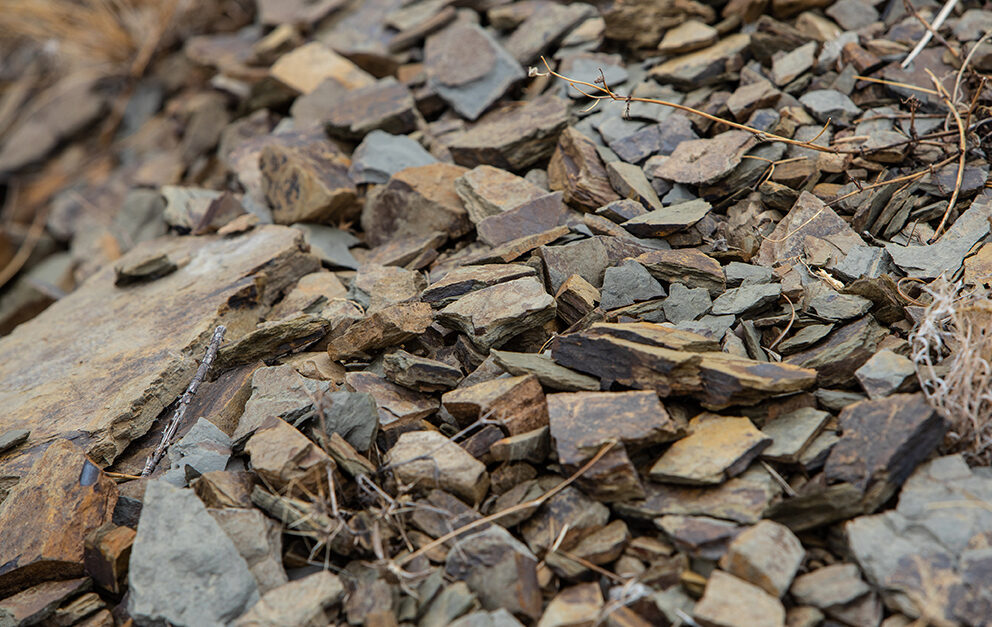
To understand a wine region and the expression of its wines, we must first look at the elements of the landscape that make up the area. One of these elements is the type of soil, which in Priorat takes on special importance because it not only shapes the landscape, but also profoundly influences the personality of the grapes that grow there.
Influence on the vine
We are talking about llicorella, a slate soil of metamorphic rock formed more than 250 million years ago, during the Paleozoic era. Grey in color, with reddish and bluish nuances, it has a laminar structure formed by thin layers of slate mixed with small veins of quartz. The result is a stony and not very compact soil.
Added to its fragility is its poor water retention. Llicorella is an impermeable rock that is poor in nutrients, which forces the vine to take root in the deeper layers to obtain more beneficial clays, thus developing longer and stronger root systems. For this reason, the plant grows at a slower rate and grape production does not exceed kg per vine, making Priorat one of the wine-growing areas in Spain with the lowest yield.
However, water stress favors the concentration of aromas, sugars and phenolic compounds in the grapes. It also makes the vine more resistant to drought, since by penetrating deeper, the roots access small water reserves that last longer in dry periods.
Expression in the wine
In the wine, thanks to the low grape production, it is expressed with greater aromatic intensity and flavor. These are wines with body, good structure and firm tannins, but above all they stand out for their mineral notes: sensations of hot stone, graphite or slate, which provide complexity and character. The concentration, structure and balance also make them wines with great aging potential.